How to Double Your Event Bookings Without Spending on Marketing
How to Double Your Event Bookings Without Spending on Marketing
You don't need more leads. You need to convert the ones you already have.
The Marketing Trap
Most venue owners facing slow bookings immediately think: \"We need more marketing.\"
They invest in Facebook ads, Google campaigns, SEO services, and social media management. Money flows out. Some leads trickle in. But bookings don't increase proportionally.
Why? Because they're pouring water into a leaky bucket.
Here's the uncomfortable truth: most banquet halls are already getting enough leads to double their bookings. They're just losing 40-60% of those opportunities due to poor conversion processes.
Before spending another rupee on marketing, fix your conversion problem. The ROI is immediate and the results are dramatic.
The Math That Changes Everything
Let's say you currently get 100 inquiries per year and convert 30% into bookings (industry average). That's 30 events annually.
Now imagine you improve your conversion rate to 60% without getting a single additional lead. You'd book 60 events—double your current volume—with zero marketing spend.
That scenario isn't fantasy. It's what happens when venues fix their conversion problems.
The best part? Improving conversion is largely free. It doesn't require advertising budgets. It requires better systems and processes.
Strategy 1: Respond Within 5 Minutes
Here's a stat that should terrify you: 78% of customers buy from the company that responds first.
Not the cheapest. Not the best. The fastest.
Yet most venues respond to inquiries in hours or days. By then, the prospect has already started conversations with three competitors. You're fighting uphill from a disadvantaged position.
The 5-Minute Rule
Respond to every inquiry within 5 minutes. If that sounds impossible with your current setup, that's exactly why you need better systems.
What Fast Response Looks Like
Lead comes in via website at 9 PM? Automated acknowledgment sent immediately, with personal follow-up first thing in the morning. Lead comes via phone during business hours? Captured in system, response within 5 minutes. Lead comes via social media? Notification alert, response within minutes.
The Impact
Venues that implement the 5-minute rule typically see conversion rates jump 30-50% overnight. No marketing required. Just faster response times.
Think about it: if you're currently converting 30% of leads and response speed improvement alone boosts that to 40-45%, you've added 10-15 bookings annually with zero additional marketing spend.
Strategy 2: Perfect Your Follow-Up Sequence
Most inquiries don't convert on first contact. They need multiple touchpoints. But most venues give up after one or two attempts.
This is pure waste. You've already invested in generating that lead. Following up costs almost nothing but dramatically increases conversion.
The 7-Touch Follow-Up Sequence
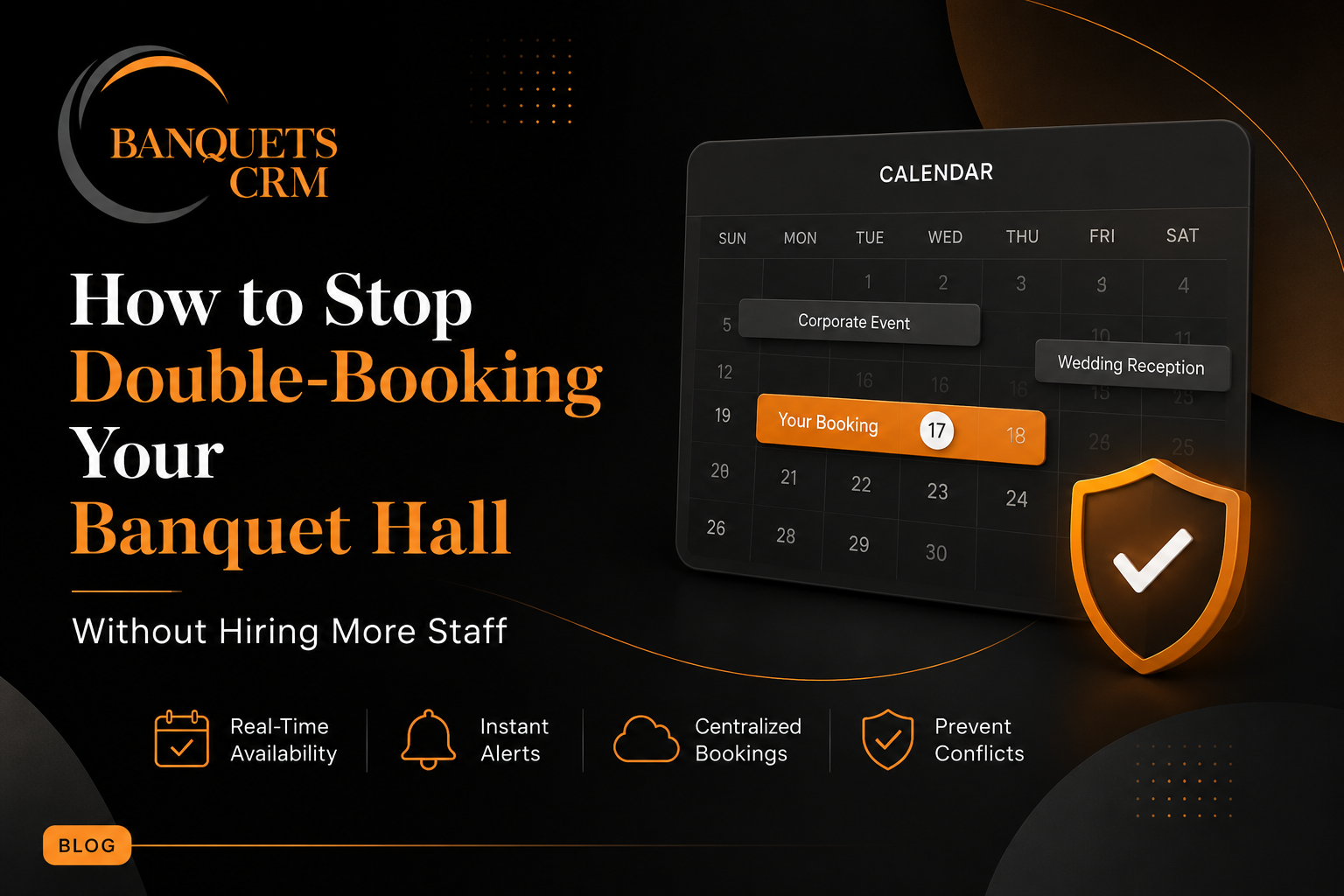
Day 0: Immediate response to inquiry
Day 1: Follow up asking if they have questions
Day 3: Share photos of similar events you've hosted
Day 7: Offer to schedule a venue visit
Day 14: Share a limited-time incentive
Day 21: Final check-in
Day 30: Move to nurture sequence for future opportunities
Why This Works
People book venues at different speeds. Some decide immediately. Others take weeks. A systematic follow-up sequence ensures you stay top-of-mind throughout their decision process without being pushy.
The Numbers
Venues with no follow-up system convert maybe 20% of leads. Those with systematic 7-touch sequences convert 45-60%. That's 2-3x more bookings from the same lead volume.
If you're getting 100 inquiries annually, the difference between 20% and 50% conversion is 30 additional bookings. At an average booking value of Rs. 200,000, that's Rs. 6,000,000 in additional revenue—from better follow-up alone.
Strategy 3: Make Quote Generation Instant
Slow quote generation kills deals. Every hour delay in sending a quote reduces your chances of winning that booking by roughly 10%.
Manual quote creation takes 30-45 minutes. By the time you've crafted something, the customer has received quotes from three competitors and is comparing options.
The Speed Advantage
When you can generate accurate, professional quotes in under 2 minutes, you create a massive competitive advantage. You're in the customer's inbox before competitors have even started their calculations.
Quote Quality Matters
Fast quotes must also be good quotes: professional formatting that builds confidence, detailed breakdown showing exactly what's included, multiple package options at different price points, and clear next steps for booking.
The Psychological Edge
Fast, professional quotes signal efficiency and organization. Customers think: \"If they're this responsive during sales, imagine how well they'll handle my event.\"
Slow quotes signal the opposite: disorganization and potentially unreliable service.
Strategy 4: Offer Multiple Package Options
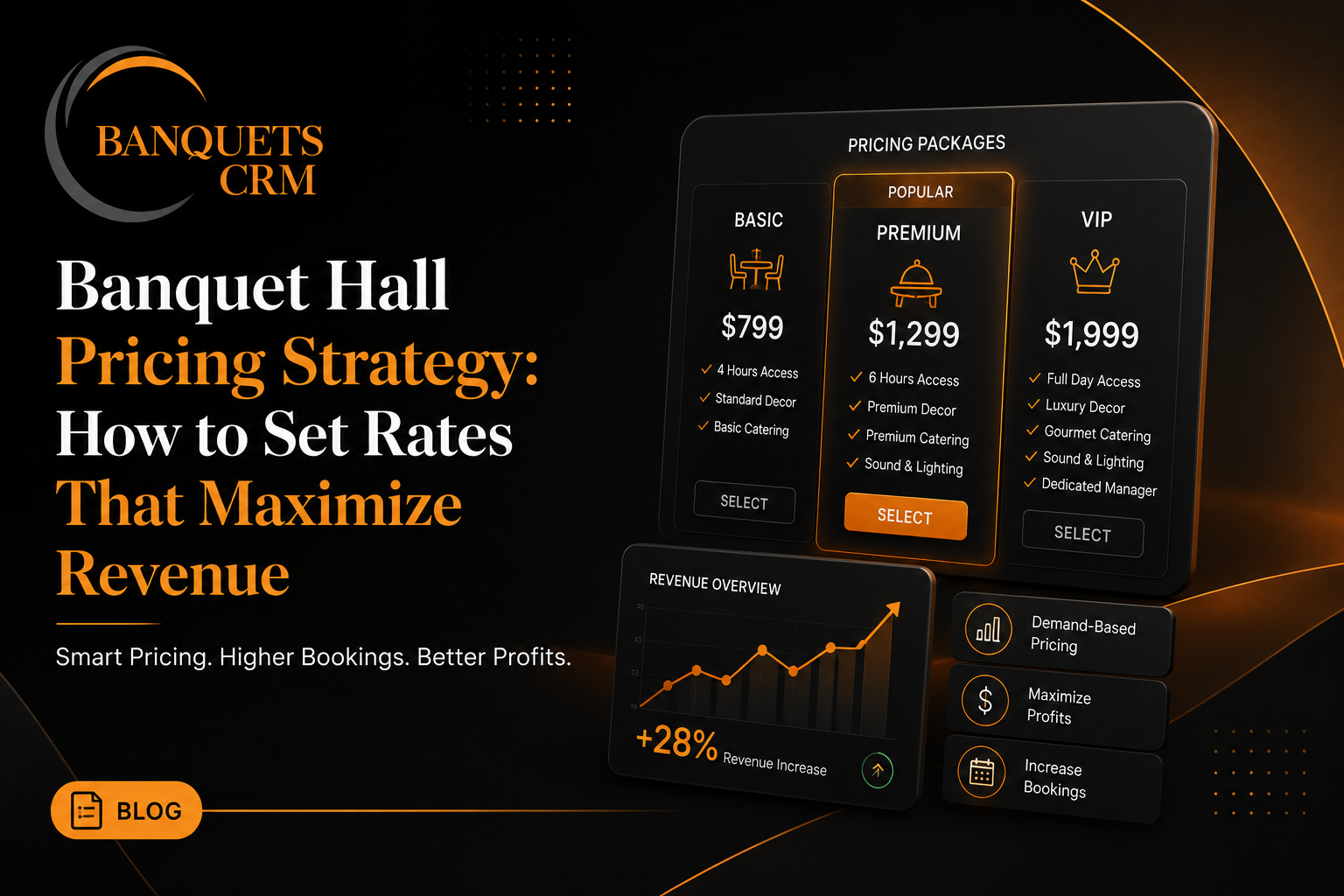
Never send a single-option quote. Always provide 3 options at different price points.
Why? Psychology. When customers see one option, their decision is yes/no. When they see three options, their decision is which one—a much easier mental process.
The Three-Tier Structure
Basic Package: Your standard offering at competitive pricing. This anchors the lower end and shows you're affordable.
Premium Package: Enhanced version with upgrades. This is where you want most customers to land.
Luxury Package: Top-tier option with all the bells and whistles. Even if few choose this, it makes the premium package seem reasonable by comparison.
The Results
Venues offering single-option quotes close maybe 25-30% of opportunities. Those offering three-tier options close 40-50% and often at higher average values because customers naturally gravitate toward the middle option.
Strategy 5: Reduce Friction in the Booking Process
Every extra step between interest and commitment is an opportunity to lose the customer.
Common Friction Points
Requiring in-person visits before providing quotes, complicated deposit payment processes, unclear booking terms and conditions, slow response to questions during decision phase, and requiring multiple back-and-forth exchanges for simple changes.
Friction Reduction Tactics
Provide detailed quotes before requiring venue visits. Make deposit payments easy with multiple payment options. Clearly state all terms upfront in quotes. Respond to questions within hours, not days. Empower your team to make simple modifications without needing management approval.
The Impact
Every friction point you remove increases conversion. Collectively, friction reduction can boost conversion rates by 15-25%.
Strategy 6: Leverage Social Proof
People trust other people more than they trust your marketing claims.
Collecting Social Proof
Ask satisfied customers for reviews on Google, Facebook, and wedding platforms. Request permission to use photos from successful events. Gather testimonials highlighting specific benefits. Track the number of events you've hosted successfully.
Using Social Proof
Include testimonials in quotes and proposals. Share event photos when following up with similar requests. Mention your success metrics: \"We've successfully hosted over 500 weddings in the past 5 years.\" Display reviews prominently on your website and social media.
The Psychology
Social proof reduces risk perception. When prospects see that others have trusted you and been happy, they're more likely to book with confidence.
Venues that effectively use social proof see 10-20% higher conversion rates compared to those that don't.
Strategy 7: Upsell Strategically
The easiest sale is to someone who's already buying. Yet most venues miss massive upsell opportunities.
The Right Time to Upsell
After they've decided on the base package but before final confirmation. When discussing specific event requirements and preferences. When they mention special needs or wants. During follow-up conversations leading up to the event.
What to Upsell
Premium menu upgrades for key moments (cocktail hour, dessert service). Enhanced decoration packages that create more impressive visuals. Add-on services like upgraded lighting, premium linens, or extended time. Special touches like welcome drinks, late-night snacks, or custom elements.
How to Upsell Without Being Pushy
Present upsells as solutions to specific needs. Show visuals of what upgrades look like. Frame them as \"popular choices\" or \"what most customers add.\" Make pricing transparent and easy to understand. Never pressure—offer and let them decide.
The Revenue Impact
If you can increase average booking value by just 10-15% through strategic upselling, you're adding significant revenue without needing a single additional booking.
On 50 events at Rs. 200,000 each, a 15% increase in average value adds Rs. 1,500,000 in annual revenue.
Strategy 8: Prevent Booking Abandonment
You've done everything right. The customer is interested. They've received a quote. Then... silence.
This is booking abandonment, and it happens more than you think.
Why Customers Abandon
They got distracted and forgot to follow up. They're waiting for something (budget approval, input from others). They have concerns they haven't voiced. A competitor swooped in with a better offer. The decision became overwhelming.
Re-Engagement Tactics
If no response after 2-3 days, send a gentle check-in: \"Just wanted to see if you had any questions about the quote we sent.\" After 5-7 days, offer something valuable: photos of recent similar events, answers to common concerns, or a limited-time incentive. After 2 weeks, make a final attempt with urgency: \"Your preferred date is still available, but we're getting inquiries. Would you like to schedule a call to discuss?\"
The Recovery Rate
Proper abandonment recovery can save 20-30% of deals that would otherwise be lost. That's found money—customers you've already invested in engaging.
Strategy 9: Optimize Your Availability Response
How you respond to availability inquiries dramatically impacts conversion.
The Wrong Way
Customer: \"Is June 15th available?\"
You: \"Yes, it's available.\"
Result: Conversation stalls. They're collecting information, not ready to commit.
The Right Way
Customer: \"Is June 15th available?\"
You: \"Yes, June 15th is available! It's actually one of our most popular dates—we've hosted some beautiful summer weddings then. Would you like me to send you a detailed quote for your specific needs, or would you prefer to schedule a quick call to discuss your vision for the event?\"
Result: You've created momentum and given them clear next steps.
The Principle
Never give information without moving the conversation forward. Every interaction should have a purpose: gathering details, building relationship, or advancing toward commitment.
Strategy 10: Track and Optimize Continuously
You can't improve what you don't measure.
Key Metrics to Track
Total inquiries received per month. Source of each inquiry (website, social, referral, etc.). Response time to each inquiry. Number of follow-ups per lead. Conversion rate overall and by source. Average time from inquiry to booking. Average booking value. Reasons for lost opportunities when possible.
How to Use This Data
Identify your best-performing lead sources and invest more there. Spot bottlenecks in your conversion process. See which team members convert best and learn from them. Test improvements and measure impact. Continuously refine your approach based on real results.
The Improvement Loop
Venues that track metrics and optimize continuously typically see steady month-over-month improvement in conversion rates. Small incremental gains compound into substantial business growth.
Real-World Example: Lahore Banquet Hall
Let me share a real example of how these strategies work in practice.
A mid-sized banquet hall in Lahore was getting about 120 inquiries per year but only booking 30 events (25% conversion). They were spending heavily on Facebook ads to generate more leads.
We implemented these strategies over 90 days:
- Set up systems for 5-minute response times
- Implemented 7-touch follow-up sequence
- Moved to instant quote generation
- Started offering 3-tier package options
- Collected and displayed social proof
- Trained staff on strategic upselling
Results after 90 days with the same 120 annual inquiries: 68 bookings (57% conversion rate). Average booking value increased from Rs. 180,000 to Rs. 215,000. Total annual revenue increased from Rs. 5,400,000 to Rs. 14,620,000. Zero additional marketing spend.
They more than doubled revenue by converting leads they were already getting.
The Implementation Plan
Don't try to implement everything at once. Here's a realistic 30-day rollout:
Week 1: Response Speed
Focus solely on responding to inquiries within 5 minutes. Set up systems, alerts, and processes to make this possible. This alone will boost conversion.
Week 2: Follow-Up System
Implement your 7-touch follow-up sequence. Document it, set up reminders, and train your team. Apply it to all new leads plus re-engage recent leads that went cold.
Week 3: Quote Optimization
Speed up quote generation and implement 3-tier packaging. Create templates, standardize pricing, and empower your team to send quotes quickly.
Week 4: Polish and Measure
Add social proof to your communications. Start tracking key metrics. Fine-tune processes based on early results. Train team on upselling and friction reduction.
After 30 days, you'll see measurable improvement. After 90 days, the transformation will be dramatic.
Why This Works Better Than Marketing
Marketing has its place. But optimization delivers better ROI because marketing costs money per lead while optimization multiplies the value of every lead, marketing results take time to compound while optimization shows immediate improvement, marketing is external and competitive while optimization is internal and controllable, and marketing can become expensive with diminishing returns while optimization continues compounding as processes improve.
Plus, here's the kicker: once you've optimized conversion, then marketing becomes incredibly valuable. Pouring leads into an optimized system delivers exponential returns.
But doing it backward—marketing without optimization—is burning money.
Common Objections (And The Truth)
\"We're Too Busy to Implement New Processes\"
You're busy because your current processes are inefficient. These optimizations save time—dramatically. The hour you invest in setup saves 10+ hours weekly going forward.
\"Our Customers Don't Care About Response Speed\"
Yes, they do. They're shopping multiple venues. Whoever responds first has an enormous advantage. Your customers might not explicitly say this, but their behavior proves it.
\"We Already Follow Up Pretty Well\"
Track it objectively. Most venues think they follow up well but actually follow up inconsistently or give up too early. The data usually reveals big gaps.
\"Our Conversion Rate Is Already Good\"
Good is relative. Even if you're at 40% (above average), improving to 60% adds 50% more bookings. That's substantial growth from your existing lead flow.
The Real Cost of Not Optimizing
Every month you operate with a 30% conversion rate instead of a 60% conversion rate, you're leaving massive revenue on the table.
If you get 10 inquiries per month:
- At 30% conversion: 3 bookings × Rs. 200,000 = Rs. 600,000/month
- At 60% conversion: 6 bookings × Rs. 200,000 = Rs. 1,200,000/month
That's Rs. 600,000 monthly or Rs. 7,200,000 annually in lost revenue. From leads you're already getting.
How long can you afford to leave that money on the table while debating whether to optimize?
The Bottom Line
Doubling your bookings doesn't require doubling your marketing budget. It requires converting more of the opportunities you already have.
The strategies outlined here—fast response, systematic follow-up, instant quotes, multi-tier options, friction reduction, social proof, strategic upselling, abandonment recovery, optimized conversations, and continuous improvement—collectively can double or even triple your conversion rate.
The best part? Most of these are free to implement. They require better systems and processes, not bigger budgets.
So before you increase marketing spend, ask yourself: Am I converting every possible booking from my current lead flow?
If the answer is no—and for most venues, it is—then optimization is your highest-leverage opportunity for growth.
Fix the leak before adding more water to the bucket.