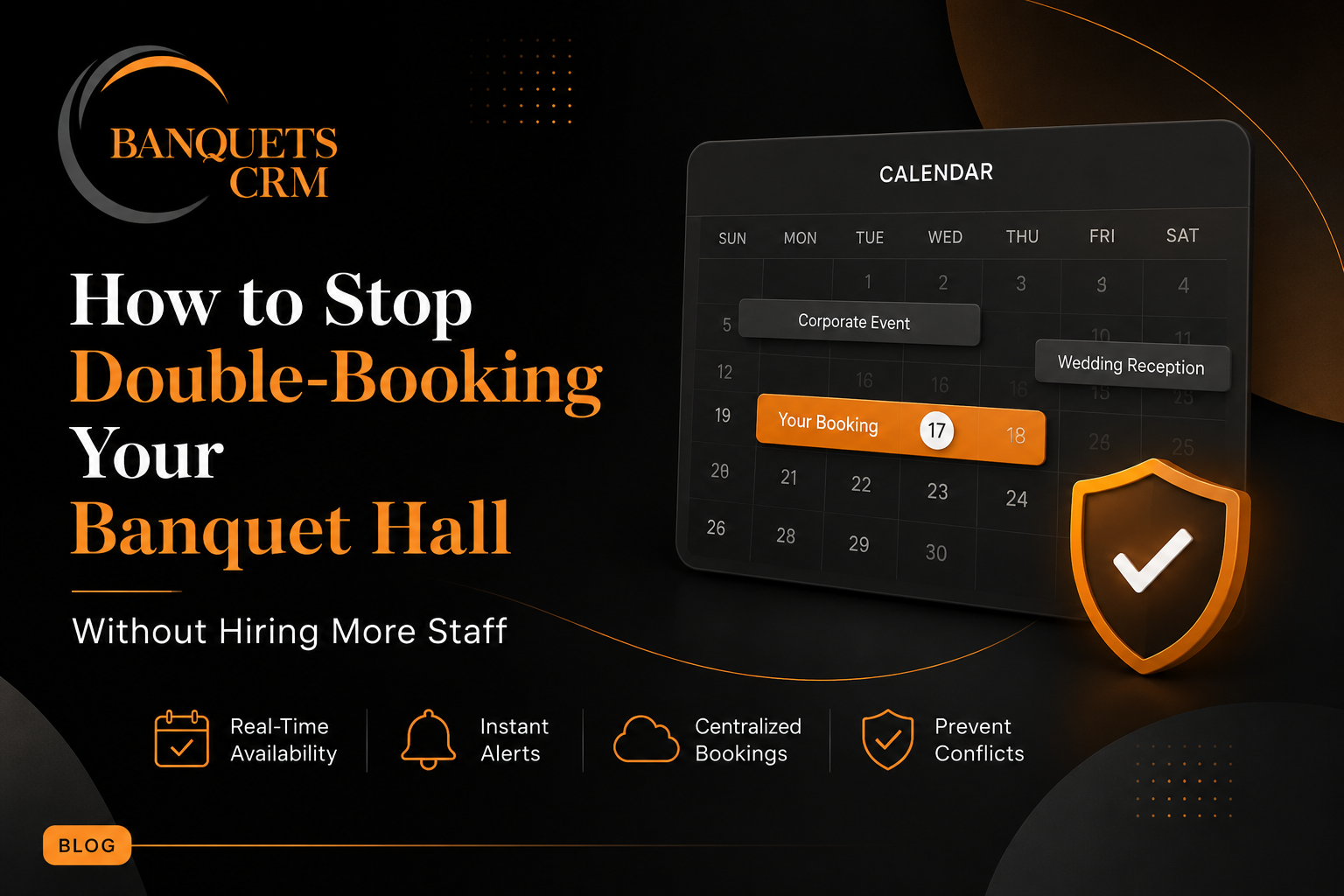
How to Stop Double-Booking Your Banquet Hall Without Hiring More Staff
A double booking is one of the most expensive mistakes a banquet hall can make. It is not just the refund or the discount you offer to make it right — it is the client who tells five other people, the vendor who no longer trusts your dates, and the staff scramble on the day itself. Most venues that double-book are not careless. They are simply managing availability across too many disconnected places at once.
Why Double Bookings Actually Happen
In almost every case we have seen, the root cause is the same: availability lives in more than one system. A hall might track confirmed events in a paper diary, tentative holds in a spreadsheet, and phone inquiries in someone's memory. The moment two staff members are taking calls at the same time, or a manager forgets to update the shared sheet after a call, the door is open for a conflict.
It gets worse with multi-space venues. A hall with a main ballroom, a garden area, and a smaller function room often needs to track availability per space, per time slot, and sometimes per resource (chairs, sound system, catering staff) — not just per date. A single shared calendar rarely captures that level of detail cleanly.
The Real Cost of a Double Booking
- Direct revenue loss — refunding or discounting one of the two bookings to keep the peace.
- Reputation damage — event planning is a small, word-of-mouth-driven industry. One bad story travels far.
- Staff time — hours spent apologizing, rearranging, and finding a backup venue for the client you cannot accommodate.
- Vendor trust — caterers, decorators, and photographers who get moved around a conflicting date are less likely to prioritize your venue next time.
Three Fixes That Actually Work
1. Track availability by time slot, not just by date
Most double bookings happen because two events were booked on the "same day" without checking whether their actual time windows overlapped, or whether setup and breakdown time was accounted for. A lunch event that runs until 3pm and an evening event that starts setup at 2pm are, in effect, double-booked — even though they are technically "different times."
2. Give every staff member the same real-time view
If your front desk, your sales team, and your manager are checking three different sources of truth, conflicts are a matter of time, not chance. A single shared system that everyone checks before confirming anything removes the guesswork entirely.
3. Make holds visible, not just confirmations
A lot of venues only track confirmed bookings and let tentative holds live in someone's head. Tentative holds need to block the calendar too, with an expiry, so a second inquiry for the same date is flagged before anyone makes a promise they cannot keep.
How BanquetsCRM Handles This
This is exactly the problem our venue management and time slot scheduling tools were built to solve. Every space in your venue gets its own real-time availability calendar, tentative holds block the slot automatically, and every staff member — whether they are on the front desk or answering a call from home — sees the same live information. No shared spreadsheet, no "let me check with the manager and call you back."
If you run a banquet hall or event venue, this is one of the fastest wins available: the core booking and venue tools are part of the free plan, so there is no reason to keep running availability out of a notebook.
Ready to see it in action? Start free — no credit card required.