How to Manage Recurring Corporate Client Contracts and Invoicing Without the Headache
A corporate client who books you for a quarterly all-hands or an annual conference is worth far more over time than a single wedding client — but recurring clients also come with a different set of operational challenges. The invoicing and contract terms that work fine for a one-off event start to break down when you're managing the same client four times a year, sometimes with different budget approvers each time.
Why Recurring Corporate Clients Are Different
A one-off event has a single quote, a single invoice, and a clean start and end. A recurring client often has evolving requirements each time — a slightly different guest count, a new venue for variety, a different internal budget owner — while still expecting the relationship and pricing history to be remembered and honored.
Where Recurring Client Management Breaks Down
- Pricing inconsistency — quoting a returning client differently than last time, without a clear reason, damages trust fast.
- Lost history — not having last event's final numbers on hand when a new budget approver asks "what did this cost last time?"
- Manual invoice creation from scratch — rebuilding a similar invoice every quarter instead of working from a template tied to the client.
- Payment terms drift — informally allowing longer payment windows for a "regular" client until it becomes an unspoken, unenforced norm.
What Works Better
Keep a client-level history, not just an event-level one
Every invoice and event for a given corporate client should be visible together, so you can answer "what did we charge last time" or "how many events have we run for them this year" without digging through old email threads.
Standardize payment terms in writing, every time
Even with a trusted, long-term client, restating payment terms on every invoice — due date, accepted methods, late payment terms — keeps expectations consistent regardless of who on their side is handling the approval this quarter.
Track outstanding balances actively, not reactively
Recurring clients are exactly the ones most likely to have an invoice quietly go unpaid past due date, because the relationship feels informal. A system that flags overdue invoices automatically removes the awkwardness of having to notice and chase it manually.
Bringing Contracts and Invoicing Into One Place
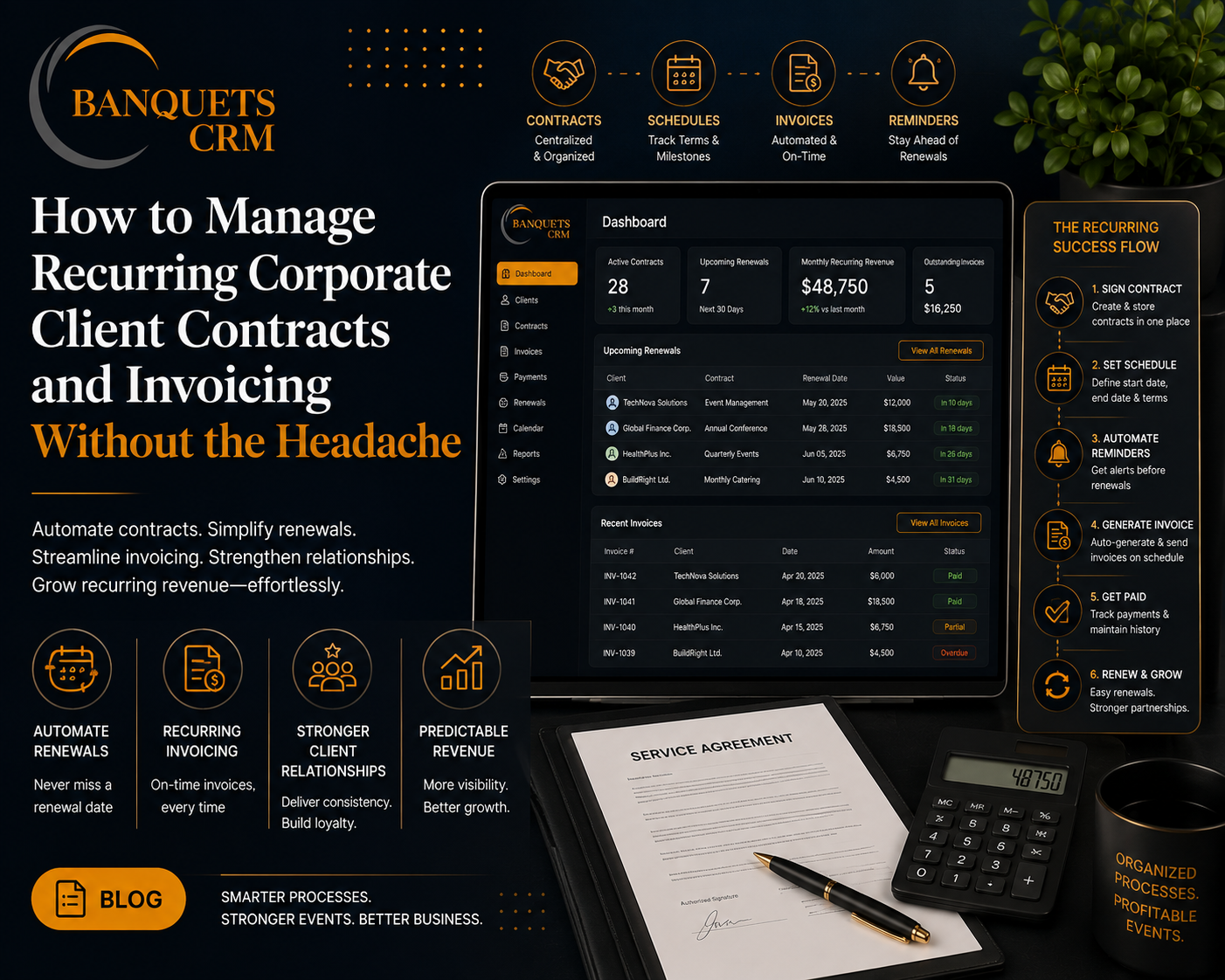
BanquetsCRM's customer management keeps a full history tied to each client, so recurring corporate accounts carry their event and invoice history forward automatically. Invoicing handles payment tracking, deposits, and automatic overdue reminders — so recurring clients get consistent terms every time, without you having to manually track who owes what.
If corporate events are a growing part of your business, especially repeat clients, getting this system right early saves a significant amount of admin time as that side of the business scales. Start free today.